

If you’re trying to figure out the best areas to buy property in Dubai in 2026, you’re really choosing between three big ideas: proven city cores, established lifestyle communities, and up‑and‑coming growth corridors. The “right” area for you depends less on what’s trendy and more on your budget, risk appetite, and whether you care more about yield, long‑term capital appreciation, or lifestyle.
This guide walks you through the top places to buy property in Dubai in 2026, from high‑rental‑yield workhorses to ultra‑luxury villa enclaves and emerging investment hotspots.
Dubai Property Market Outlook 2026: Why Location Matters More Than Ever
The Dubai housing market heading into 2026 is being shaped by three structural forces:
- Population growth and immigration – More residents, more tenants, more end‑user demand.
- Infrastructure‑led growth – The Al Maktoum International Airport expansion, Etihad Rail, new highways and metro extensions are creating new “gravity centres”.
- Lifestyle‑driven master communities – Golf, lagoons, green parks, wellness and smart‑city concepts are now standard, not nice‑to‑have.
Because of that, the best areas to buy property in Dubai in 2026 fall into three buckets:
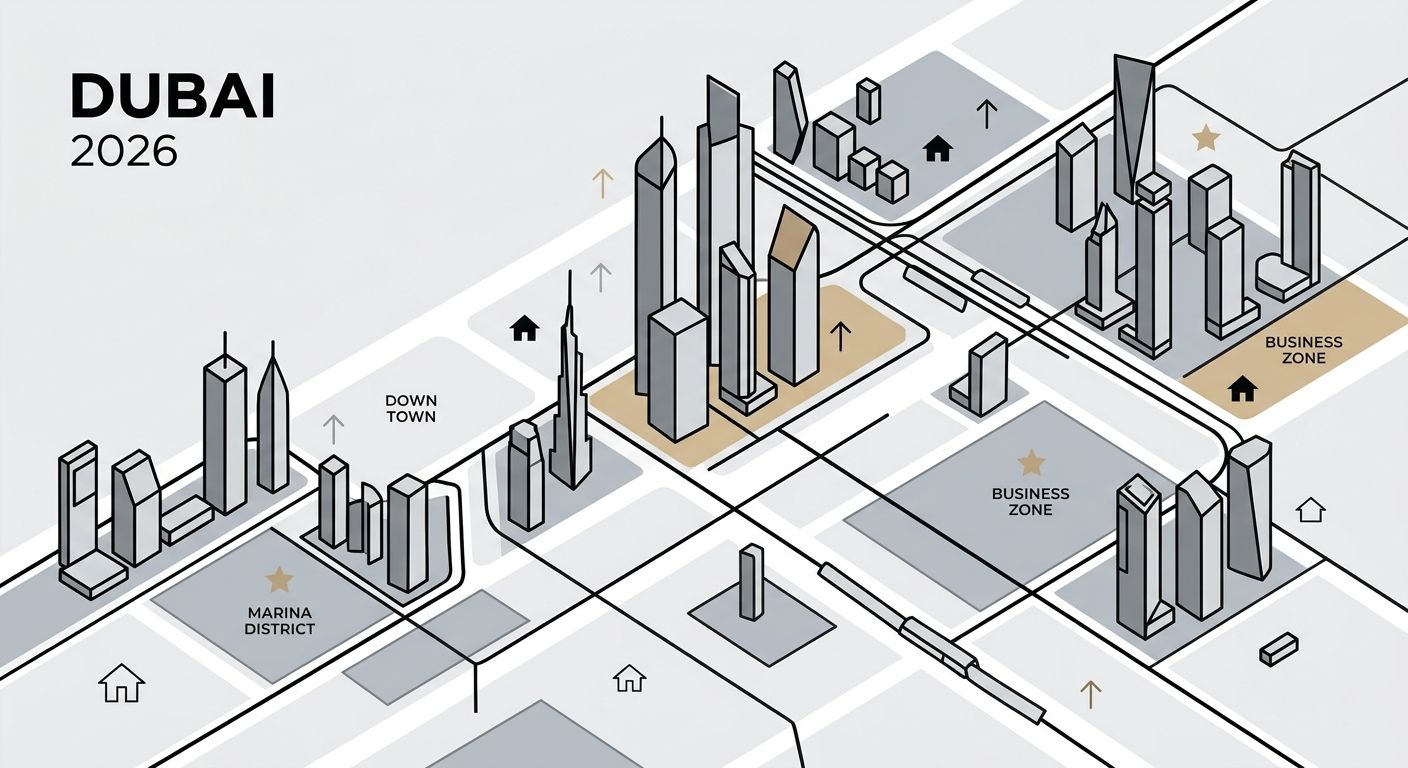
- Core prime CBD & waterfront: Downtown Dubai, Dubai Marina, Business Bay, Palm Jumeirah.
- Mature lifestyle communities: Dubai Hills Estate, JVC, Sobha Hartland, Bluewaters, Port de La Mer, Tilal Al Ghaf, Emaar Beachfront.
- Emerging / up‑and‑coming areas: Palm Jebel Ali, Dubai Creek Harbour, Dubai South, Dubai Islands, Expo City, The Valley, The Oasis by Emaar, Ghaf Woods, The Acres, Ghantoot / Al Jurf, Rashid Yachts & Marina.
Your job is to match these to your strategy: high rental yield, best ROI, or lifestyle and prestige.
How to Decide What “Best” Means for You in 2026
Before you zoom into districts and price per square foot, get clear on three things:
- Your main objective
- Maximise rental yield now? You’ll look at high‑demand, mid‑ticket apartments in proven communities.
- Maximise long‑term capital appreciation? You’ll skew towards off‑plan and growth‑corridor locations.
- Prioritise lifestyle / prestige? You’ll target low‑density villas, waterfront and branded residences.
- Your budget band
- Under AED 1.5M: affordable apartments and studios in JVC, Business Bay, early‑phase Dubai South / Expo City.
- AED 1.5M–4M: central and waterfront apartments in Business Bay, Dubai Marina, Dubai Creek Harbour, select units in Dubai Hills Estate, Emaar Beachfront.
- AED 4M+: villas in Dubai Hills Estate, Tilal Al Ghaf, The Valley, The Acres, plus waterfront in Palm Jumeirah, Emaar Beachfront, Port de La Mer, Sobha Hartland, Bluewaters, The Oasis by Emaar, Ghantoot.
- Ready vs off‑plan
- Ready property: immediate rental income, less delivery risk, clearer current yields.
- Off‑plan property: lower entry prices, flexible payment plans, higher upside if you can hold until handover and stabilisation.
Core Prime Areas in Dubai for 2026: Downtown, Marina, Business Bay, Palm Jumeirah
These are the established, high‑liquidity neighbourhoods that international investors recognise instantly. They’re rarely “cheap”, but they offer strong fundamentals, deep rental markets, and capital stability.
Downtown Dubai – Global Trophy Address & Short‑Term Rental Magnet
Positioning: Downtown remains Dubai’s flagship CBD and lifestyle core, anchored by Burj Khalifa, Dubai Mall and Dubai Opera. As an address, it’s one of the most recognisable in the world.
Why buy in Downtown Dubai in 2026?
- Enduring global demand: High‑net‑worth individuals consistently target Downtown for pied‑à‑terre apartments and branded residences.
- Short‑term rental strength: Tourism and business travel keep occupancy high for holiday homes and serviced units.
- Limited new supply: There’s essentially no new raw land; that scarcity supports long‑term capital stability.
Typical pricing & rental yields (2026):
- 1‑bedroom apartments: around AED 2.0M – 2.8M
- 2‑bedroom apartments: around AED 3.5M – 5M
- Average gross rental yield: approximately 5.5%
Best for you if: you want a blue‑chip, liquid asset in the very heart of the city and are comfortable with slightly lower yields in exchange for prestige and stability.
Dubai Marina – High‑Rental‑Yield Waterfront Workhorse
Positioning: Dubai Marina is one of the top areas to invest in Dubai real estate for yield. It combines a waterfront promenade, dense residential towers and easy access to employment hubs.
Why buy in Dubai Marina in 2026?
- Consistently high rental demand: Young professionals, couples and small families gravitate here.
- Infrastructure & connectivity: Metro, tram and proximity to Dubai Internet City, Media City and JBR.
- Balanced profile: You get both lifestyle and performance, not just one or the other.
Typical pricing & yields (2026):
- 1‑beds: around AED 1.6M – 2.3M
- 2‑beds: around AED 2.5M – 3.8M
- Average gross rental yield: roughly 6–7%
Investor tip: In many portfolios, compact 1‑bedroom units in quality buildings (e.g. Marina Gate, Marina Promenade) often show some of the highest rental yields among luxury waterfront communities.
Best for you if: you prioritise high rental yields in a proven, liquid community and like the energy of an urban waterfront lifestyle.
Business Bay – Central, High‑Yield & Still Growing
Positioning: Often dubbed “Dubai’s Manhattan”, Business Bay blends office towers, hotels and modern residential buildings along the Dubai Canal, right next to Downtown.
Why buy in Business Bay in 2026?
- More affordable than Downtown: Lower entry prices but virtually the same central convenience.
- Strong tenant base: Demand from executives, entrepreneurs and young professionals working nearby.
- Ongoing transformation: Canal‑front promenades, improved infrastructure and placemaking are still unfolding.
Typical pricing & yields (2026):
- Studios: about AED 950K – 1.2M
- 1‑beds: around AED 1.5M – 2M
- Average gross rental yield: roughly 6%
Off‑plan upside: Canal‑front off‑plan developments are widely seen as among the best areas to buy property in Dubai for short‑ to mid‑term capital appreciation, with 2027–2028 as key years as projects complete.
Best for you if: you’re a first‑time or mid‑budget investor looking for central location with 6%+ yield and future growth potential.
Palm Jumeirah – Iconic Ultra‑Luxury & Capital Preservation
Positioning: Palm Jumeirah is still the benchmark for luxury waterfront communities in Dubai—trophy villas, branded resorts and penthouses.
Why buy in Palm Jumeirah in 2026?
- Finite supply: No new land; beachfront villas and prime sea‑view apartments are inherently scarce.
- Global UHNWI magnet: Properties are often purchased for status, privacy and second‑home use, not just yield.
- Branded residences: Royal Atlantis, Six Senses Residences, Waldorf Astoria and others elevate demand.
Typical pricing & yields (2026):
- 2‑bed apartments: about AED 4M – 6M
- Villas: from roughly AED 15M – 30M+
- Average gross rental yield: around 5%
Best for you if: you’re focused on ultra‑luxury living, brand cachet and long‑term capital stability more than squeezing every extra percentage point of yield.
Mature Lifestyle Communities: Best Residential Areas in Dubai for Families & Mid‑ to High‑End Investors
These communities combine strong amenities, schools and retail with healthy rental demand. They’re some of the best residential communities in Dubai in 2026 for long‑term family living and steady growth.
Dubai Hills Estate – The “Green Heart” & Family Favourite
Positioning: A vast Emaar master‑planned community with an 18‑hole golf course, Dubai Hills Mall, schools and parks—often described as Dubai’s “green heart”.
Why buy in Dubai Hills Estate in 2026?
- Family‑centric planning: Schools, medical centres, malls and parks baked into the master plan.
- Strategic location: Between Downtown and Dubai Marina, with great road connectivity.
- Quality of stock: High‑spec villas, townhouses and apartments that attract end‑users and long‑term renters.
Typical pricing & yields (2026):
- 3‑bed villas: roughly AED 4.5M – 6M
- 4‑bed villas: roughly AED 6.5M – 9M
- Average gross rental yield: around 5%
Best for you if: you want to live in the property or hold long‑term in a prestige family community with strong capital appreciation prospects.
Jumeirah Village Circle (JVC) – Affordable High‑Yield Community
Positioning: One of the most affordable freehold communities with parks, schools and a huge diversity of mid‑rise buildings.
Why buy in JVC in 2026?
- Lower entry prices: Much cheaper than prime cores yet still well located.
- Strong rental demand: Families and young professionals appreciate the value and amenities.
- Future connectivity: Planned metro improvements and ongoing infrastructure upgrades.
Typical pricing & yields (2026):
- Studios: about AED 600K – 800K
- 1‑beds: about AED 900K – 1.3M
- Average gross rental yield: around 7%
Best for you if: you’re a first‑time buyer or yield‑focused investor looking for high ROI communities in Dubai with a low entry ticket.
Emaar Beachfront – Branded Seafront with Strong Yields
Positioning: A new strip of luxury waterfront towers inside Dubai Harbour, nestled between Dubai Marina and Palm Jumeirah, with its own private beach.
Why buy in Emaar Beachfront in 2026?
- Prime micro‑location: Direct access to Sheikh Zayed Road and quick reach to Marina and Palm.
- 1.5 km of private beach: A major differentiator for long‑term value and holiday‑home demand.
- Brand strength: Emaar’s track record and the Elie Saab‑branded “Grand Bleu” add prestige.
Typical pricing & yields (2026):
- 1‑beds: about AED 3M – 3.8M
- 2‑beds: about AED 4.5M – 6M
- Average gross rental yield: roughly 6%
Best for you if: you want luxury waterfront apartments with both lifestyle appeal and solid rental yields, especially in the short‑term rental segment.
Tilal Al Ghaf – Lagoon, Eco‑Luxury & Family Appeal
Positioning: A nature‑led, master‑planned community near Dubai Sports City built around a large Crystal Lagoon, with a big focus on sustainability.
Why buy in Tilal Al Ghaf in 2026?
- Lagoon lifestyle: Residents enjoy beach‑style living and water sports inside the community.
- Sustainability theme: Eco‑friendly practices and green spaces align with global wellness trends.
- Range of homes: From 3–5 bed townhouses and villas to 6‑bed mansions.
Best for you if: you want a family‑friendly villa community with a resort‑style environment and believe nature‑led communities will keep commanding a premium.
Sobha Hartland – Green, Design‑Led Luxury Near Downtown
Positioning: Part of Mohammed Bin Rashid City along the Dubai Water Canal, Sobha Hartland combines lush landscapes with high‑spec villas and apartments a short drive from Downtown.
Why buy in Sobha Hartland in 2026?
- Green micro‑climate: Hundreds of plant and tree species create a noticeably greener environment.
- Proximity: Quick access to Downtown and major arteries.
- Design and finishes: Often pitched at ultra‑luxury level with spa areas, private cinemas and multiple lounges.
Best for you if: you value privacy, greenery and premium design but don’t want to compromise on centrality.
Bluewaters Island – Boutique Island Prestige Next to Marina
Positioning: A small man‑made island off JBR, home to Ain Dubai and a limited number of high‑end residential buildings and villas.
Why buy in Bluewaters in 2026?
- Low‑density, boutique feel: Fewer buildings and a calmer, resort‑like atmosphere.
- Proximity without the bustle: You’re next to Marina and JBR but insulated from their intensity.
- Design‑led living: Popular with buyers who treat property as an extension of personal brand and hospitality.
Best for you if: you want a small, exclusive island community with strong prestige value and limited competing supply.
Port de La Mer – Urban Waterfront Near Old Jumeirah
Positioning: A coastal district in Jumeirah 1 with 2.5 km of sandy beaches, marina promenades and city‑meets‑sea views.
Why buy in Port de La Mer in 2026?
- Balanced lifestyle: Beachfront living combined with quick access to older Jumeirah and Downtown.
- Limited‑scale, stylish product: More boutique than mega‑development, with design‑driven residences.
- Long‑term scarcity: Freehold waterfront close to central Dubai is inherently constrained.
Best for you if: you want waterfront living but prefer the “city rhythm” of older Jumeirah over New Dubai’s skyscraper clusters.
Emerging & Up‑and‑Coming Areas in Dubai for Property Investment in 2026
These communities sit at the intersection of infrastructure expansion and new master‑planning. They’re some of the best places to buy property in Dubai for long‑term capital appreciation if you’re comfortable with earlier‑stage risk and off‑plan exposure.
Palm Jebel Ali – Next‑Generation Iconic Palm
Positioning: A larger sister to Palm Jumeirah, relaunched as a mega high‑end waterfront community of villas, mansions and branded resorts.
Why buy in Palm Jebel Ali in 2026?
- Early‑cycle entry: Primarily off‑plan, with pricing below where a fully mature island should eventually sit.
- Waterfront scarcity: As citywide beachfront options tighten, this becomes Dubai’s next major seafront reservoir.
- Flagship positioning: Set to be one of Dubai’s most prestigious addresses in the 2030s.
Best for you if: you’re a long‑horizon investor comfortable with a 5–10+ year appreciation timeline and want exposure to Dubai’s future ultra‑luxury waterfront supply.
Dubai Creek Harbour – “Future Downtown” with High Growth Potential
Positioning: A mega Emaar waterfront project on Dubai Creek, master‑planned at city scale with the upcoming Creek Tower and Creek Mall.
Why buy in Dubai Creek Harbour in 2026?
- Strategic location: Close to Dubai International Airport and Ras Al Khor wildlife sanctuary.
- Skyline & nature views: Downtown skyline views across the water plus natural mangroves.
- Future major hub: Planned as one of Dubai’s next urban anchors, similar in ambition to Downtown.
Typical pricing & yields (2026):
- 1‑beds: about AED 1.5M – 2.2M
- 2‑beds: about AED 2.8M – 3.5M
- Average gross rental yield: roughly 6%
Best for you if: you want a blend of waterfront lifestyle, strong rental demand and long‑term appreciation as the district matures and the Creek Tower / Mall come online.
Dubai Islands – New Multi‑Island Waterfront Destination
Positioning: A four‑island waterfront cluster off the coast, designed for residential living, tourism and entertainment.
Why buy in Dubai Islands in 2026?
- Early entry into a new waterfront corridor: Luxury beachfront apartments across 16 planned buildings.
- Different island characters: From resort‑oriented to entertainment and residential.
- Holiday rental upside: Strong positioning for the short‑term rental and second‑home market in coming years.
Best for you if: you’re targeting future holiday‑home demand and like the concept of a new, multi‑island waterfront ecosystem.
Dubai South – Airport & Logistics‑Led Growth Corridor
Positioning: A massive district around Al Maktoum International Airport and the Expo legacy site, envisioned as a major residential, commercial and logistics hub.
Why buy in Dubai South in 2026?
- Infrastructure‑led growth: The airport expansion and Etihad Rail are long‑term drivers of population and employment.
- Affordable entry prices: Very competitive price per square foot versus central districts.
- Alignment with Dubai 2040 plan: Positioned as a key future urban centre.
Best for you if: you want budget‑friendly investment with long‑term upside and are comfortable holding through the development cycle.
Expo City – Sustainable, Smart‑City Residential Hub
Positioning: Built on the Expo 2020 site, Expo City is pitched as a sustainability‑focused innovation hub integrated with Dubai South and Al Maktoum Airport.
Why buy in Expo City in 2026?
- Sustainability and smart living: New projects like Sidr Residences and Terra Heights emphasise eco‑friendly design and smart systems.
- Corporate and educational draw: Appeals to global companies, institutions and talent drawn to the Expo legacy.
- Strategic location: Excellent highway connectivity and proximity to the expanding airport.
Best for you if: you’re bullish on tech‑driven, sustainable communities and want to be in an early‑stage smart‑city environment.
The Valley – Emaar Suburban Living at Accessible Prices
Positioning: An Emaar community along Al Ain Road geared towards families wanting villas and townhouses in a quieter, suburban setting.
Why buy in The Valley in 2026?
- Family‑friendly master plan: Large green spaces, adventure parks, sports and community facilities.
- More affordable than inner‑city villa communities: An accessible way into Emaar‑branded family living.
- Off‑plan growth: As the community matures, early buyers can ride price growth.
Best for you if: you’re a family or investor targeting mid‑ticket villas with long‑term rental and resale demand.
The Acres – New‑Gen Dubailand Villas
Positioning: A Meraas villa/townhouse project in Dubailand with a focus on outdoor living, parks and greenery.
Why buy in The Acres in 2026?
- Low‑rise, family‑centric environment: A clear alternative to dense tower clusters.
- Near‑term handovers: First deliveries expected around 2026, meaning your off‑plan wait is shorter.
- Strong developer brand: Meraas’ track record in lifestyle projects supports future demand.
Best for you if: you want a fresh villa community with strong family appeal and plan to benefit from the “post‑handover uplift” many new communities experience once fully operational.
Ghaf Woods – Forest‑Inspired Wellness Community
Positioning: A Majid Al Futtaim project near Global Village pitched as a forest community with a cooler micro‑climate, car‑free zones and wellness focus.
Why buy in Ghaf Woods in 2026?
- Nature‑first design: Forest trails, sky gardens and lush landscaping.
- Wellness and car‑free living: Portions of the community are designed for pedestrians and cyclists, emphasising health.
- Unique positioning: A “forest neighbourhood” in Dubai stands out from typical apartment stock.
Best for you if: you want to align your investment with wellness, sustainability and differentiated product, and you’re happy to hold through the build‑out.
The Oasis by Emaar – Ultra‑Luxury, Low‑Density Villa Enclave
Positioning: A 100‑million‑sq‑ft master community of villas and mansions built around waterways and green corridors, intentionally low density and ultra‑luxurious.
Why buy in The Oasis by Emaar in 2026?
- Exclusivity: Villa‑only, spacious plots, extensive water frontage and resort‑level amenities.
- Design‑forward villas: New phases like Marèva and Palmiera Collective offer cutting‑edge designs.
- Strategic yet secluded: Good connectivity to major roads while preserving a private feel.
Best for you if: you’re an ultra‑high‑net‑worth buyer looking for brand‑new flagship villas for personal use and capital preservation.
Ghantoot & Al Jurf – Low‑Density Coastal Corridor Between Dubai & Abu Dhabi
Positioning: A coastal stretch between Dubai and Abu Dhabi drawing high‑end, low‑density developments, effectively extending Dubai’s luxury beachfront north.
Why buy in Ghantoot / Al Jurf in 2026?
- Seclusion and nature: Larger plots, fewer neighbours, and more natural landscapes than in city waterfronts.
- Design‑led projects: Developments like Bayn by ORA and Jacob & Co Beachfront Living by Ohana target style‑conscious buyers.
- Bi‑city appeal: Practical for people whose lives span both Dubai and Abu Dhabi.
Best for you if: you prioritise space, privacy and design over proximity to urban nightlife, and you’re betting on the broader regional luxury coastline trend.
Rashid Yachts & Marina – Heritage Port Turned Luxury Marina Community
Positioning: Redevelopment of the historic Mina Rashid port into a superyacht marina and upscale residential waterfront.
Why buy in Rashid Yachts & Marina in 2026?
- Heritage + luxury: Combines Dubai’s maritime history with a new, high‑end marina lifestyle.
- Centrality: Minutes from Downtown and Dubai Creek.
- Niche appeal: Great fit for boat/yacht owners and those who want marina living without Dubai Marina’s density.
Best for you if: you want a distinctive waterfront niche community with strong lifestyle credentials and solid long‑term demand from a specific tenant/owner profile.
Best Areas in Dubai 2026 by Investor Profile
To cut the noise, match your profile to these shortlists.
For Highest Rental Yields (6–7%+)
- Jumeirah Village Circle (JVC): Affordable studios and 1‑beds; one of the top high‑rental‑yield areas in Dubai.
- Dubai Marina: 1‑beds in quality buildings; excellent occupancy and rent levels.
- Business Bay: Studios and 1‑beds near office clusters and the canal.
- Dubai Creek Harbour / Emaar Beachfront: For investors willing to pay more for branded waterfront while still targeting around 6% yields.
For Long‑Term Capital Appreciation
- Dubai Creek Harbour: As Creek Tower, Creek Mall and full master plan evolve.
- Business Bay (off‑plan along the canal): As it matures into a more complete financial and lifestyle hub.
- Palm Jebel Ali: Iconic long‑term waterfront play.
- Dubai South & Expo City: Direct beneficiaries of airport expansion and logistics‑led growth.
- The Oasis by Emaar, Tilal Al Ghaf, Ghaf Woods, The Acres, The Valley: Early‑cycle master communities focused on families and lifestyle.
For Ultimate Luxury & Prestige
- Palm Jumeirah: Evergreen ultra‑luxury icon, especially frond villas and branded residences.
- The Oasis by Emaar: Ultra‑luxury low‑density villa community with strong global HNWI interest.
- Bluewaters, Port de La Mer, Sobha Hartland: Boutique, design‑led prime communities.
- Emaar Beachfront: Branded seafront apartments with private beaches.
- Ghantoot / Al Jurf: Secluded, design‑driven coastal villas between Dubai and Abu Dhabi.
For First‑Time Buyers in 2026
- JVC: Affordable, high yields, flexible off‑plan payment plans.
- Business Bay: Central location with solid rents and manageable ticket sizes.
- Dubai Hills Estate: For higher budgets that want a family home and long‑term appreciation.
- The Valley & The Acres: Suburban villa/townhouse living at relatively accessible prices compared with inner‑city villa districts.
FAQs About Buying in Dubai’s Best Areas in 2026
Is 2026 a good time to buy property in Dubai?
Market data and on‑the‑ground sentiment suggest that 2026 is favourable for buyers who are realistic about holding periods. Population growth, regulated property laws, and mid‑cycle infrastructure expansion (airport, rail, roads) are supportive. The key is to buy in communities where demand is underpinned by either employment hubs, waterfront / lifestyle scarcity, or family‑centric amenities.
Are off‑plan properties in emerging communities too risky?
Off‑plan always carries construction and timing risk, but in Dubai the risk profile varies heavily by developer and location. In many of the up‑and‑coming areas (Business Bay canal, Dubai Creek Harbour, Palm Jebel Ali, Dubai South, Expo City, Tilal Al Ghaf, Ghaf Woods, The Acres, The Valley, The Oasis), you’re essentially trading shorter‑term uncertainty for lower entry prices and better payment plans. If your horizon is 5–10 years and you stick with strong master developers in strategic areas, off‑plan can be a very rational way to capture long‑term upside.
Which areas are best for short‑term rentals and holiday homes?
Areas with strong tourism pull and beachfront / landmark proximity typically perform best for holiday rentals:
- Downtown Dubai (Burj Khalifa / Dubai Mall catchment)
- Dubai Marina & JBR
- Emaar Beachfront
- Palm Jumeirah
- Dubai Islands and Dubai Creek Harbour (as they mature)
Which areas are the most “future‑proof” in terms of infrastructure?
Districts directly linked to the Al Maktoum Airport expansion, Etihad Rail and the Dubai 2040 Master Plan have strong structural tailwinds. That includes Dubai South, Expo City, parts of the Dubai Creek Harbour catchment, and fringe areas that will benefit from upgraded roads and transit connectivity. Within the inner city, Business Bay and Dubai Hills Estate benefit from being between key employment and lifestyle hubs.
Next Steps: Narrowing Down Your Best‑Fit Areas
To translate this into a shortlist, pin down three numbers and two preferences:
- Your budget range (purchase price, not just deposit)
- Your target rental yield (or your minimum acceptable return)
- Your holding period (3, 5 or 10+ years)
- Occupancy plan (own use, long‑term rent, or holiday home)
- Ready vs off‑plan comfort level
Once you’re clear on those, the broad 2026 Dubai market breaks into very specific pathways. A sub‑AED 1.5M investor seeking yield will look at JVC, Business Bay and early‑phase Dubai South / Expo City. A AED 3M–4M buyer wanting lifestyle and decent ROI will weigh Dubai Marina, Dubai Creek Harbour and Emaar Beachfront. A AED 10M+ villa budget shifts the conversation towards Dubai Hills Estate, Tilal Al Ghaf, The Oasis and prime waterfronts like Palm Jumeirah or Ghantoot / Al Jurf.
The more precise you are about your profile, the easier it becomes to identify the best areas to buy property in Dubai in 2026 that align with your goals rather than someone else’s headline returns.