

If you’re planning to buy property in Dubai, one of the first decisions you’ll face is simple to ask but tricky to answer: freehold vs leasehold property in Dubai – which is actually better for you?
This isn’t just a technical legal detail. The choice will affect your rights, costs, exit strategy, and how that property fits into your long‑term plans in the UAE and beyond. In day‑to‑day conversations with buyers, this is usually where confusion starts – and where smart planning can save you a lot of headaches later.
What Is Freehold vs Leasehold Property in Dubai?
Let’s start by breaking down what each ownership type really means in the Dubai real estate market.
What is freehold property in Dubai?
A freehold property in Dubai gives you:
- Full ownership of both the property and the land it stands on.
- Permanent ownership with no time limit – it doesn’t expire.
- Your name on a Dubai Land Department (DLD) title deed as the legal owner.
With freehold ownership, you can:
- Live in the property yourself.
- Rent it out long term (and in many freehold zones, as holiday homes, subject to local rules).
- Sell it whenever you choose.
- Mortgage it, if the bank approves.
- Pass it on to your heirs as part of your estate.
In other words, freehold equals complete and permanent ownership of that real estate asset within a designated freehold area in Dubai.
What is leasehold property in Dubai?
A leasehold property in Dubai works very differently. Here, you:
- Do not own the land.
- Buy the right to use and occupy the property for a fixed period – usually 30 to 99 years (99‑year leasehold is common).
- Own that lease interest, not the underlying land.
During the lease term, you can usually:
- Live in the property yourself.
- Rent it out (if your lease contract allows).
- Sell or transfer the remaining years of the lease to someone else.
When the lease term ends, ownership reverts to the freeholder (the land owner) unless you negotiate and sign a renewal or extension. Think of leasehold as a very long, legally protected “super‑rental” with more rights than a normal tenancy, but not the same as full freehold ownership.
Freehold vs Leasehold: Key Differences at a Glance
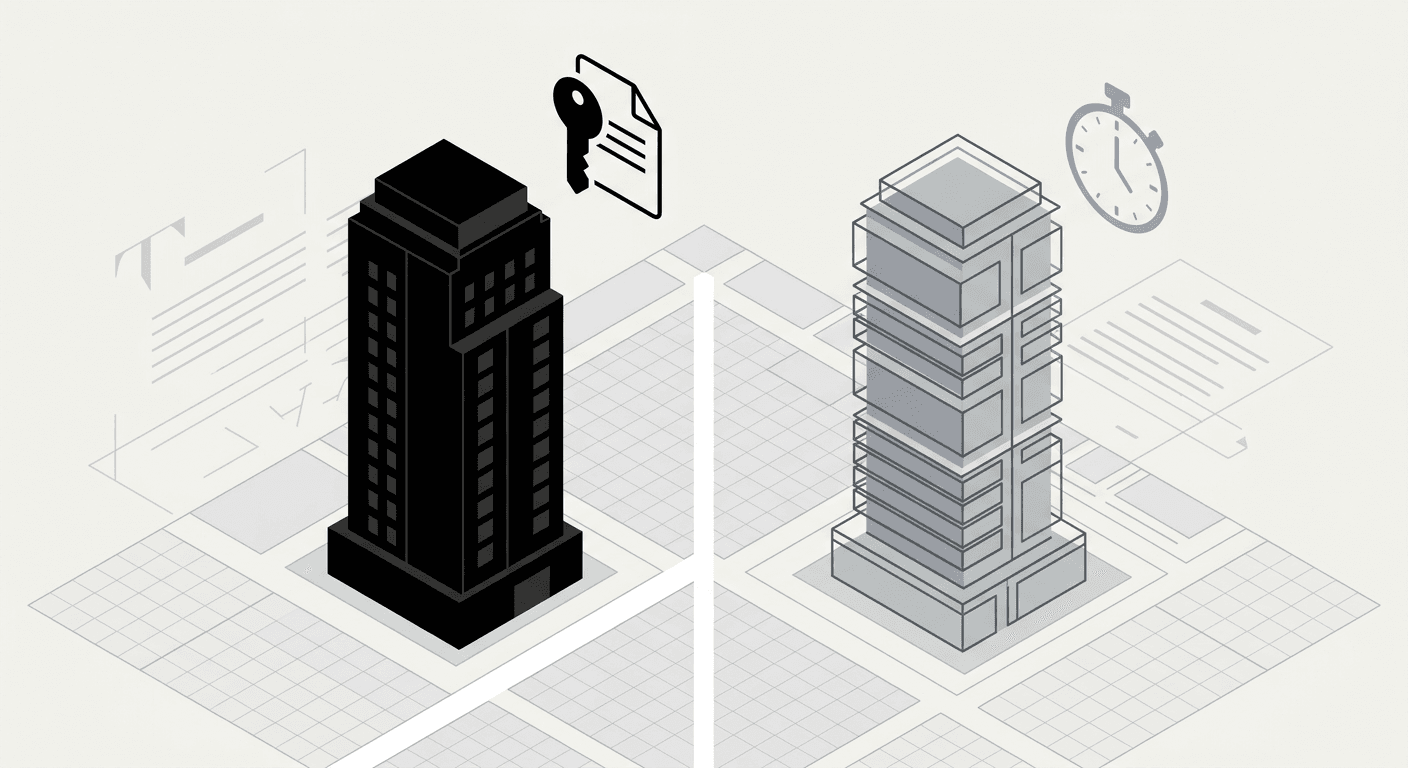
To understand the difference between freehold and leasehold property in Dubai, it helps to compare them side by side.
| Factor | Freehold Property in Dubai | Leasehold Property in Dubai |
|---|---|---|
| What you own | Property + land (full ownership) | Right to use the property; land stays with freeholder |
| Duration | Indefinite, no expiry | Fixed term, usually 30–99 years |
| Title | DLD title deed in your name | Lease agreement registered with DLD |
| Rights to sell | Can sell at any time, full market value | Can sell only remaining lease term |
| Renovations & alterations | Broad freedom within building and community rules | Often need written freeholder approval for major works |
| Inheritance | Perpetual asset; can be passed to heirs | Heirs may inherit remaining lease term, but not land |
| Ground rent | No ground rent (you own land) | May pay ground rent to freeholder in addition to service charges |
| Maintenance responsibility | Ultimate responsibility for your property; pays service charges | Major structure usually freeholder’s responsibility; you handle internal wear & tear |
| Price profile | Higher upfront investment, strong capital appreciation | Lower entry price, potential value decline as lease term shortens |
Legal Framework & Eligibility for Foreign Buyers
Dubai’s rules on property ownership are very clear, but you need to know which laws apply to which type of property.
Legal framework for freehold property
- Governed mainly by Dubai Law No. 7 of 2006 (Real Property Registration Law).
- Regulates:
- Who can own freehold property.
- How property is registered at the Dubai Land Department.
- Title deeds and dispute resolution.
- Allows:
- UAE citizens and GCC nationals.
- Certain companies fully owned by them.
- Non‑UAE nationals to own in designated freehold zones.
When you buy freehold, the ownership is registered in your name and you receive an official DLD title deed confirming 100% property ownership in Dubai (within that zone).
Legal framework for leasehold property
- Primarily falls under Dubai Law No. 26 of 2007 (Dubai Tenancy Law), which governs landlord‑tenant relationships.
- Applies to:
- Standard rental contracts.
- Long‑term leasehold agreements.
- Covers:
- Lease duration and renewal.
- Payment terms.
- Rights and obligations of both parties.
- Dispute resolution processes.
Your leasehold contract is registered with the DLD, which makes your rights enforceable for the duration of the lease.
Can foreigners buy property in Dubai?
Yes. As a foreigner or expat, you can:
- Buy freehold property in designated freehold areas.
- Buy leasehold property in various other districts.
Common questions include “Can expats buy property in Dubai freehold or leasehold?” and “Can a foreigner have 100% property ownership in Dubai?” – the answer is yes, but only as freehold ownership inside designated zones and subject to standard registration at the Dubai Land Department.
Pros and Cons of Freehold Property in Dubai
To decide whether freehold vs leasehold is better in Dubai for you, you need to weigh the pros and cons against your goals.
Advantages of buying freehold property in Dubai
- Complete and permanent ownership You’re not on a countdown clock. You don’t have to worry about what happens after 30 or 99 years. This is ideal if you see Dubai as a long‑term base or a core piece of your global portfolio.
- Full control and flexibility
Within community and building regulations, you can:
- Renovate or upgrade your unit.
- Switch between living in it and renting it out.
- Sell whenever market conditions suit you.
- Capital appreciation & stronger resale
Prime freehold areas in Dubai – Downtown, Dubai Marina, Palm Jumeirah, Dubai Hills Estate and others – have historically shown strong capital growth and rental demand. That makes freehold attractive for:
- Long‑term investors seeking capital appreciation.
- Buy‑to‑hold strategies focusing on generational wealth.
- Inheritance and legacy planning A freehold property is an asset you can structure into your long‑term family planning. You can pass it to heirs, use it as collateral, or hold it as a safe, tangible store of value in a global city.
- Choice of communities and amenities
Most of Dubai’s master‑planned, amenity‑rich communities are freehold:
- Waterfront freehold zones like Dubai Marina and Palm Jumeirah.
- Golf‑course communities such as Dubai Hills Estate and Arabian Ranches.
- New city‑living hubs like Business Bay and Dubai Creek Harbour.
Disadvantages of buying freehold property in Dubai
- Higher upfront cost
You’re paying for permanent ownership of both the structure and the land. Even with competitive prices by global standards, prime freehold assets require:
- Higher down payments in absolute terms.
- Higher Dubai Land Department transfer fees simply because the property value is higher.
- Ongoing financial responsibilities
In addition to mortgage payments (if any), you’ll cover:
- Internal maintenance and repairs.
- Service charges and community fees set by the owners’ association or developer.
- Insurance and utility connections.
- Entry barrier for some first‑time buyers If your budget is tight, the areas and unit sizes you can access as a freehold buyer may be more limited. In practice, this is where many people start comparing freehold vs leasehold options across different districts.
Pros and Cons of Leasehold Property in Dubai
Advantages of buying leasehold property in Dubai
- Lower entry cost
Leasehold ownership often comes with a more affordable price tag than equivalent freehold options, especially in central, established locations where freehold simply isn’t available. That makes leasehold:
- Attractive for first‑time buyers.
- Appealing to budget‑conscious investors testing Dubai’s real estate market.
- Access to mature, central districts Many traditional neighbourhoods – such as parts of Jumeirah, Al Wasl, Deira and Bur Dubai – predominantly offer leasehold structures to non‑UAE nationals. If you care most about a specific central location for lifestyle, schools or business, leasehold might be your doorway into that area.
- Reduced structural maintenance hassle
In many leasehold setups:
- Major structural repairs are handled by the freeholder or building management.
- You focus on internal upkeep and service charges.
- Suitable for defined time horizons If you only expect to stay or invest in Dubai for a specific period (for example, a 10–15 year career posting), buying a property with a long remaining lease term can effectively lock in your housing cost in that period without committing to perpetual ownership.
- Potentially attractive yields in certain areas Because entry prices can be lower, some investors target leasehold units in high‑demand rental areas to pursue income‑focused strategies, particularly when they are comfortable with the lease term and contract structure.
Disadvantages of buying leasehold property in Dubai
- Finite ownership period
This is the biggest difference between leasehold vs freehold property in Dubai. You are buying the right to use the property for a limited time, not a permanent stake in the land. As the remaining lease length shortens:
- Buyer demand can drop.
- Some banks become more conservative with mortgages.
- Valuations may soften, especially as you move closer to expiry.
- Restrictions on modifications and use
Your lease may limit:
- What renovations you can carry out.
- Whether you can sublet, and on what terms.
- Whether you can use the property for certain business activities.
- Expiry and renewal risk
At the end of a 30–99 year lease:
- The property reverts to the freeholder, unless both parties agree to renew or extend.
- Renewal will likely involve new financial terms and conditions.
- Ground rent and additional fees
Some leasehold properties involve a recurring ground rent payment to the freeholder, on top of standard service charges. You’ll want to know:
- How much ground rent you’ll pay.
- How it can be increased (indexation clauses).
- How often it’s reviewed.
Best Freehold and Leasehold Areas in Dubai
One of the most practical ways to think about freehold vs leasehold in Dubai is by looking at where each structure actually exists on the map.
Popular freehold areas in Dubai
Foreigners can buy freehold property in Dubai in a wide list of designated freehold zones. Some of the most popular freehold communities include:
- Downtown Dubai – home to Burj Khalifa and Dubai Mall, strong demand from tourists and corporates.
- Dubai Marina – established waterfront freehold area with high rental demand.
- Palm Jumeirah – iconic man‑made island with villas, apartments and hotels.
- Business Bay – mixed‑use hub adjacent to Downtown with many freehold towers.
- Dubai Hills Estate – golf‑course community, villas and apartments, very popular with families.
- Dubai Creek Harbour – emerging waterfront district with off‑plan and ready freehold stock.
- Jumeirah Lake Towers (JLT) – high‑rise freehold community with mixed residential and commercial towers.
- Jumeirah Village Circle (JVC) – value‑oriented freehold area with strong investor interest.
- Arabian Ranches – villa freehold community, family‑centric, suburban feel.
- City Walk, La Mer and newer coastal projects – freehold elements in formerly non‑freehold zones.
These freehold communities are where many investors focus for capital growth, high ROI and long‑term buy‑to‑hold strategies.
Popular leasehold / mostly leasehold areas in Dubai
Many of Dubai’s older, central villa districts are structured as leasehold areas for non‑UAE nationals. Examples include:
- Jumeirah – multiple villa communities close to the beach, schools, and key roads.
- Al Wasl – central villas and low‑rise buildings close to City Walk and Downtown.
- Al Barsha & Al Barsha South – family‑friendly districts with schools and malls; some stock is leasehold.
- Mirdif – established suburban area, primarily villas and townhouses.
- Deira – older commercial and residential heart of the city, strong rental demand.
- Bur Dubai – historic core with a mix of residential, retail and offices.
- Umm Suqeim, Umm Al Sheif, Al Safa, Al Warqaa, Al Mizhar – villa districts with various ownership models, often leasehold for non‑nationals.
Within these districts, you’ll find a mix of ownership structures, so you should always confirm whether a specific building or villa is freehold vs leasehold before you commit.
Inheritance & 100% Ownership Explained
Freehold vs leasehold and inheritance
For inheritance and family planning, the difference between freehold and leasehold is crucial:
- Freehold:
- Forms part of your estate and can be passed to heirs.
- Can be structured via wills and local inheritance planning tools (for example, DIFC wills for non‑Muslim expats).
- Acts as a genuine long‑term, intergenerational asset.
- Leasehold:
- Your heirs may inherit the remaining lease term, but not the land.
- Once the lease expires, the property reverts to the freeholder regardless of heirs, unless renewed.
100% ownership for foreigners in Dubai
If you want 100% property ownership in Dubai as a foreigner:
- You have to buy in a designated freehold zone.
- Your name (or your company’s name, where allowed) is on the DLD title deed.
- Your rights are not dependent on a local sponsor for that specific property.
In leasehold structures, you own 100% of the lease interest, but not the underlying land.
Investment Strategies: Which Ownership Type Fits Your Goals?
Whether freehold vs leasehold is “better” in Dubai depends on what you’re trying to achieve.
When freehold usually makes more sense
Freehold property in Dubai tends to be the better fit if you:
- Have a long‑term horizon (10+ years) for holding the asset.
- Want to build or preserve generational wealth or a global property portfolio.
- Care about capital appreciation and flexible exit options.
- Prefer maximum control over:
- How you use the property (live vs rent).
- How you renovate or reposition it.
- When you choose to sell.
Typical strategies include:
- Buy‑to‑hold in prime freehold areas like Downtown, Dubai Marina or Palm Jumeirah for long‑term capital growth.
- Income + appreciation mix in emerging freehold hubs such as Dubai Hills Estate, JVC or Dubai Creek Harbour.
- Family home plus investment, where you live in one freehold property and hold others for rental income.
When leasehold can be the smarter choice
Leasehold property in Dubai can be very effective if you:
- Have a tighter budget but want to own in a central or specific established area.
- Plan to stay in Dubai for a defined period and don’t necessarily need a perpetual asset.
- Care more about location and cash flow than long‑term capital appreciation.
- Prefer to avoid some aspects of full structural maintenance responsibility.
- Are comfortable with the idea that your ownership is time‑limited and that resale value will link closely to how many years are left on the lease.
Strategies might include:
- Income‑focused investments in leasehold apartments in high‑demand, older central districts like Deira and Bur Dubai.
- Stepping‑stone strategy: start with a lower‑cost leasehold, build equity and experience, then transition into freehold later once your capital base grows.
Common Misconceptions About Freehold vs Leasehold in Dubai
“Leasehold means I’m just renting, not owning.”
You are actually an owner of a long‑term lease interest, not a short‑term tenant. You can:
- Sell your remaining lease term.
- Rent the property out (if allowed by contract).
- Transfer your rights.
What you don’t own is the land or a perpetual title deed.
“Foreigners can’t buy freehold property in Dubai.”
This is outdated. Since the early 2000s, non‑UAE nationals can buy freehold in approved areas such as Downtown, Marina, Palm Jumeirah, Business Bay, Dubai Hills Estate, JLT, JVC and many others. The Dubai Land Department maintains the official map of freehold zones.
“Leasehold properties become worthless at expiry.”
Value is highly sensitive to the remaining lease duration, especially as you approach expiry. However:
- Many leases can be renegotiated or extended before they run out, subject to both parties’ agreement.
- There may be built‑in clauses that discuss extension terms – you need to read your contract.
It’s not that leasehold suddenly becomes worthless overnight, but the risk and uncertainty increase as expiry approaches, which is why valuation and financing become more conservative.
“Freehold has no ongoing costs.”
Freehold owners do avoid ground rent, but they still pay:
- Service charges and community fees.
- Maintenance, repairs and upgrades inside their unit.
- Insurance, utilities and related running costs.
You’re not paying a landlord, but you are responsible for keeping the property functional and compliant.
Practical Checklist: How to Choose Between Freehold and Leasehold
To decide between freehold vs leasehold in Dubai for your own situation, run through these questions:
- 1. How long do you plan to hold the property?
- If you expect to keep it for 10 years or more, freehold usually makes more sense.
- If your horizon is shorter or uncertain, a leasehold with a long remaining term may be perfectly adequate.
- 2. What’s your total budget – including fees?
- Factor in purchase price, DLD transfer fees, agency fees, and typical annual service charges.
- If prime freehold is out of reach, you could:
- Opt for a smaller freehold unit in an emerging area, or
- Choose a leasehold option in your preferred location.
- 3. Is your priority long‑term wealth or short‑/medium‑term flexibility?
- Long‑term wealth, inheritance and exit flexibility → freehold.
- Flexibility, lower cost, defined timelines → leasehold can work well.
- 5. How important is renovation freedom and design control?
- If you want to heavily customize your space or reposition it as a high‑end rental, freehold is usually easier.
- If you’re happy with the property as delivered and don’t plan big changes, leasehold constraints may not bother you.
- 6. Are you comfortable with the concept of lease expiry and renewal negotiations?
- If the idea of renegotiating a 30–99 year lease or planning around expiry doesn’t sit well with you, freehold removes that uncertainty.
Frequently Asked Questions About Freehold and Leasehold in Dubai
What is the main difference between freehold and leasehold property in Dubai?
With freehold, you own the property and the land permanently. With leasehold, you own the right to use the property for a fixed period (30–99 years) while the land always belongs to the freeholder.
Is freehold ownership permanent in Dubai?
Yes. In designated freehold areas and for eligible buyers, freehold ownership is indefinite. It doesn’t expire and can be sold, mortgaged, or passed to heirs, subject to UAE laws and applicable inheritance processes.
What happens after 99 years of leasehold in Dubai?
When a 99‑year leasehold expires:
- Ownership of the property reverts to the freeholder.
- You may negotiate to renew or extend the lease, but this is subject to mutual agreement and new terms.
The closer a leasehold property is to expiry, the more cautious buyers, valuers and banks tend to be.
Do leasehold properties in Dubai lose all value when the lease expires?
They lose their leasehold value if the lease isn’t renewed, because your legal right to occupy ends. Before that point, value naturally compresses as the remaining lease term shortens. However, many leases are renewed or extended well before expiry – it comes down to the specific contract and negotiations with the freeholder.
Can foreigners buy freehold property in Dubai?
Yes. Non‑UAE nationals can buy freehold property in Dubai in a wide range of designated freehold areas. You get a DLD title deed and can own 100% of the property, subject to standard regulations.
Can leasehold property be passed on to heirs in Dubai?
Your heirs can generally inherit the remaining lease term, but they do not get ownership of the land. When the lease expires, the property returns to the freeholder unless renewed.
Can you mortgage a leasehold property in Dubai?
Some banks do finance leasehold properties, but their appetite depends heavily on:
- The remaining lease term (they may require a long term remaining after loan maturity).
- The project, developer, and freeholder profile.
- Lease terms and renewal provisions.
Expect more scrutiny and sometimes stricter conditions than with freehold mortgages.
Are maintenance fees higher for leasehold properties?
Not necessarily. Service charges and community fees vary from project to project, for both freehold and leasehold. In leasehold structures, you may see ground rent on top of service charges. In freehold, you don’t pay ground rent but you still pay community fees and cover internal repairs yourself.
Is freehold better than leasehold in Dubai?
Freehold is generally better if you want long‑term stability, capital appreciation and inheritance potential. Leasehold can be better if you prioritise lower upfront cost, a specific central location, or a defined medium‑term stay. The “best” option depends entirely on your budget, timeframe, and objectives.
Bottom Line: How to Use Freehold vs Leasehold to Your Advantage
Dubai gives you two very different ways to own property:
- Freehold – complete and permanent ownership, ideal for long‑term investors, families planning roots here, and buyers looking for capital growth.
- Leasehold – long‑term but time‑limited rights, useful for entering central locations at a lower cost, or for investors and residents with clear short‑ to medium‑term plans.
If you’re clear about how long you’ll hold the asset, what you can comfortably invest, and whether inheritance planning matters to you, the decision between freehold vs leasehold in Dubai becomes far easier – and far more strategic.
If you’d like to go a step further, outline your budget, preferred community type (waterfront, central city, suburban) and expected time in Dubai, and you can build a tailored freehold or leasehold acquisition plan that aligns with your real goals rather than just following the crowd.